
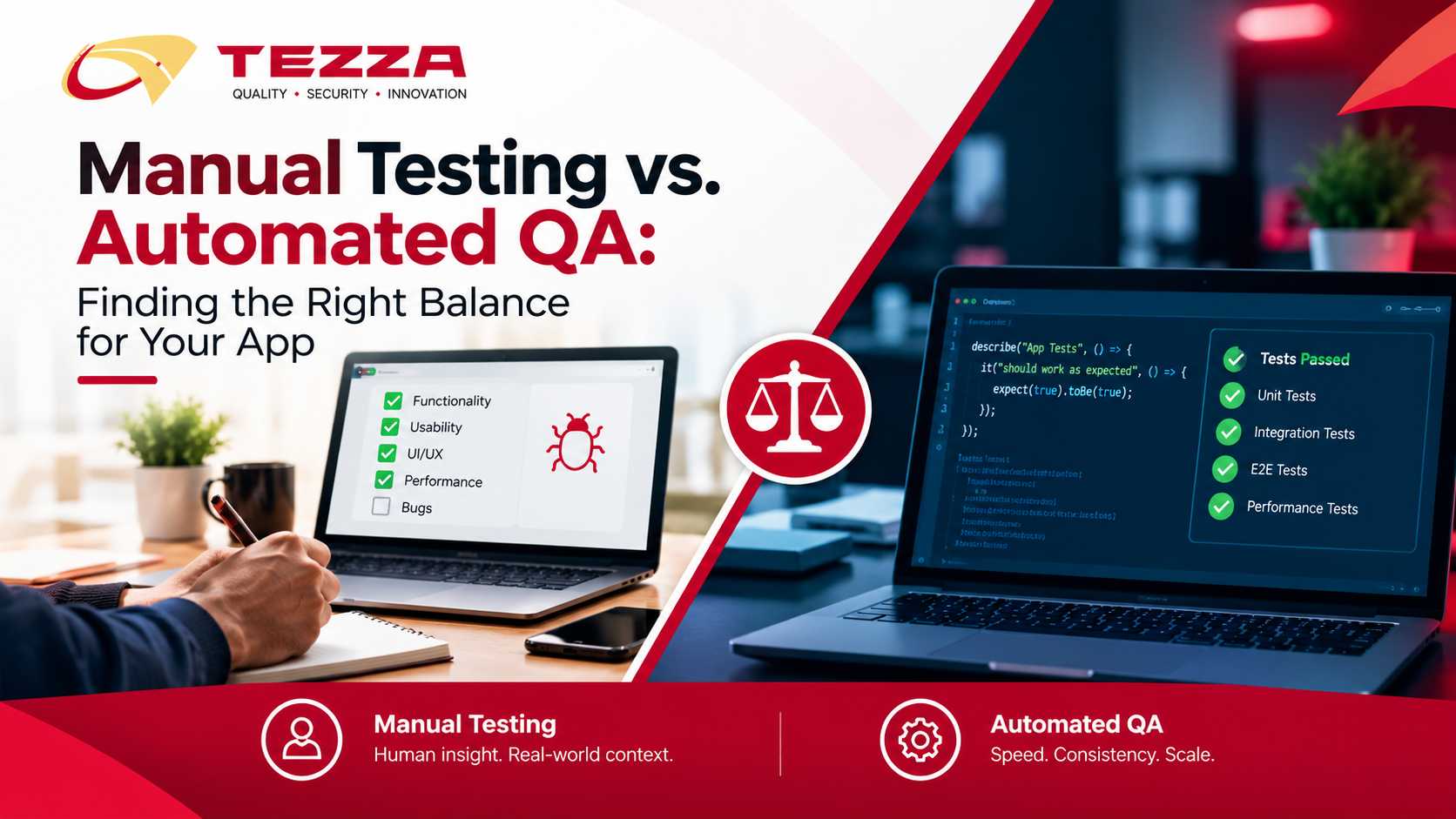
Manual Testing vs. Automated QA: Finding the Right Balance for Your App
In the fast-evolving digital marketplace, delivering a flawless digital application is no longer optional. Whether you are building an enterprise banking platform or an innovative e-commerce application, ensuring software quality is central to keeping users engaged and protecting your brand reputation.
When establishing a Quality Assurance (QA) strategy, engineering leaders and business stakeholders often face a common dilemma: Should you rely on manual testing or invest heavily in automated QA?
The short answer is that modern software development rarely thrives on an “either-or” approach. Instead, achieving true release confidence requires finding the right synergy between human ingenuity and automated precision.
Understanding Manual Testing: The Human Perspective
Manual testing involves human QA analysts who systematically interact with your application without scripts. They execute user journeys, validate designs, test edge cases, and evaluate how intuitive the system feels in real-world conditions.
Strengths of Manual Testing
- Exploratory Testing: Human testers use intuition and domain expertise to discover unscripted defects that automated scripts miss.
- User Experience (UX) and Usability Assessment: Automated scripts cannot judge whether a workflow feels clunky, visually misaligned, or unintuitive.
- Cost-Efficiency for Short Projects: For early-stage products or small features with shifting requirements, manual testing avoids the setup cost of maintaining automation frameworks.
Limitations of Manual Testing
- Human Fatigue and Human Error: Executing repetitive test cycles over long periods increases the risk of oversight.
- Time Constraints: Manual execution becomes a bottleneck in fast-paced Agile and continuous deployment cycles.
Understanding Automated QA: The Speed and Scale Engine
Automated testing utilizes software scripts and tools to execute predetermined test cases automatically against your code base. It is designed to validate outcomes quickly and repeatedly across platforms.
Strengths of Automated QA
- High-Speed Execution: Automated scripts execute hundreds of regression tests in minutes, accelerating feedback loops within CI/CD pipelines.
- Consistency and Repeatability: Tests perform identical actions every time, eliminating human oversight during routine checks.
- Load and Performance Capability: Simulating thousands of concurrent users to evaluate server resilience is only possible through automation.
Limitations of Automated QA
- High Initial Investment: Developing robust automation frameworks requires skilled engineers and significant initial time investments.
- Maintenance Overhead: Frequently changing application interfaces require constant updating of automated test scripts.
Striking the Optimal Balance: What to Automate and What to Test Manually
Achieving an efficient QA workflow requires strategic selection. The table below outlines how to divide testing tasks across your engineering lifecycle:
| Testing Activity | Recommended Approach | Primary Reason |
| Regression Testing | Automated | Highly repetitive; ensures new builds do not break existing functionality. |
| Exploratory & Ad-hoc Testing | Manual | Relies on critical thinking, human curiosity, and domain knowledge. |
| API & Backend Validation | Automated | Fast, reliable, and straightforward to execute continuously. |
| Usability & UX Validation | Manual | Requires human empathy and design evaluation. |
| Performance & Load Testing | Automated | Simulates high traffic loads that cannot be replicated manually. |
| Initial Feature Prototyping | Manual | Requirements evolve rapidly, making script creation counterproductive. |
Strategic Blueprint for App Development Success
To maximize return on investment, organizations should adopt a structured approach to hybrid QA:
“Automation handles speed and repetition, while human testers protect usability and context. A successful strategy uses automation to free human intellect for complex problem-solving.”
- Start with Risk-Based Manual Coverage: Validate functional requirements early to ensure core user journeys function properly before automating.
- Automate Continuous Integration Drivers: Convert stable, non-changing core user flows into automated smoke and regression suites.
- Embed QA into Agile Sprints: Pair automation engineers with manual functional testers to ensure test cases are designed for scriptability early in development.
How Tezza Business Solutions Can Help
At Tezza Business Solutions, we specialize in delivering tailored QA and software testing services designed to meet your business objectives. Whether you require skilled manual software testers for comprehensive functional checks or specialized API and automation engineers to build continuous integration workflows, our teams deliver seamless quality control.
Contact Tezza Business Solutions today to evaluate your software quality roadmap and optimize your testing strategy.